
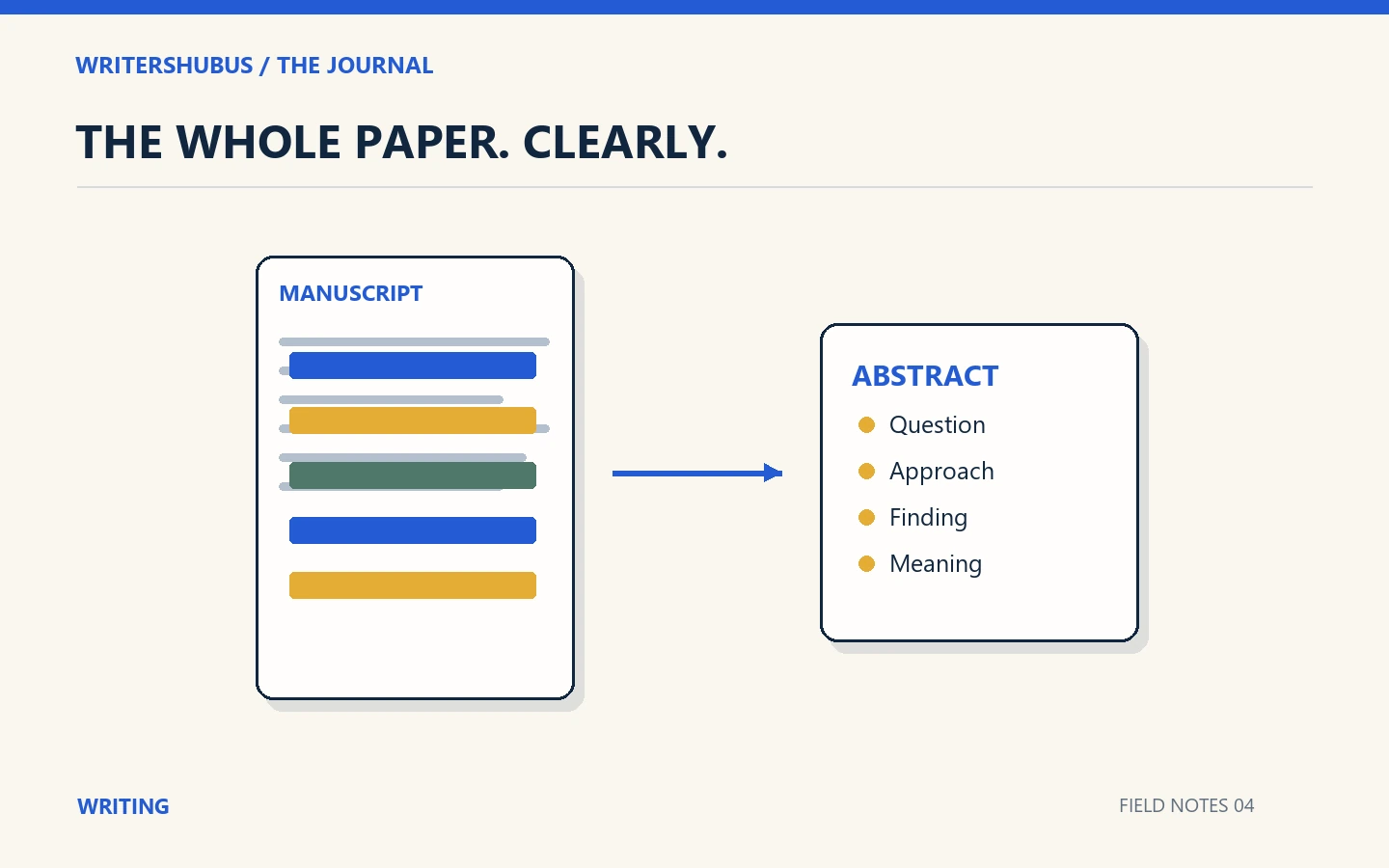
An abstract is often the last section you write and the first section someone reads. That creates a difficult task. You know the whole project, including the false starts and qualifications, but have only a small space to explain what the work actually establishes.
Treat the abstract as a precise account of the paper in front of you. The aim is to help a reader understand the question, approach, main finding and significance without asking them to guess which parts of the project are complete. Strong wording cannot compensate for a result the paper does not contain.
Check the required abstract before choosing a structure
Read the assignment, journal instructions or conference call. Establish the word limit, required headings, expected content and any rules about citations or keywords. A proposal abstract, a completed empirical study and a literature review may need different information.
The APA abstract and keywords guide provides guidance for abstracts in APA-style work. Use it when appropriate, but follow the instructions attached to your particular submission. Do not add an abstract to an assignment solely because another paper has one.
Identify whether the work is completed or proposed. A plan to interview participants should describe planned interviews. It should not use wording that implies interviews already took place. Similarly, a literature review should identify how it examines existing work rather than suggest it collected a new experimental dataset.
Extract the core information from the finished paper
Before writing polished sentences, make a short evidence sheet. Record the question, what you actually did, the most important result and the limitation that affects its interpretation. Point each item to the relevant section of the paper.
For a completed study, include the features a reader needs to understand the result. Depending on the discipline, those may include participants, materials, location, design or analytical approach. You will not necessarily have space for every detail, so choose information that changes how the finding should be read.
For an argument-based paper, identify the position, the material examined and the central contribution. “This essay discusses leadership” names a subject but does not describe an argument. A more informative evidence sheet would say which leadership claim the essay evaluates, what evidence it examines and what conclusion that analysis supports.
Build a sequence that answers the reader’s questions
A useful drafting sequence is problem, purpose, approach, finding and meaning. These are jobs for sentences, not mandatory headings. Some submissions require a structured abstract with explicit labels. Others expect a single paragraph. Keep the logic clear in either format.
| Reader’s question | Information to supply |
|---|---|
| What problem does this address? | A specific issue or gap |
| What did the work ask? | The research question or objective |
| What did the author do? | The actual design, evidence or analytical approach |
| What emerged? | The principal result or argument |
| Why does it matter? | A bounded implication and any essential limitation |
Start with enough context to make the question meaningful. A long history of the field usually leaves too little room for the contribution. If three opening sentences could appear in hundreds of other abstracts, replace them with the particular problem your paper addresses.
Make the approach concrete enough to interpret
Avoid method descriptions that sound substantial but leave the reader uncertain about what happened. “A comprehensive investigation was undertaken” does not say whether the project analysed interviews, compared documents or measured outcomes. Name the relevant action and evidence.
Use the terms your project can support. If participants were selected from one class, do not describe the sample as representative of all university students unless the design warrants that statement. If your analysis concerns a small collection of documents, name its scope instead of implying a complete account of the field.
You may need to omit a minor procedural detail, but do not omit a feature that substantially changes interpretation. The balance is discipline-specific. A useful review question is whether a reader could tell what sort of evidence stands behind the finding.
State a finding rather than advertise a discussion
An abstract for completed work should normally tell the reader the main result or conclusion expected by the submission instructions. Phrases such as “results are discussed” or “important implications are explored” consume space without identifying either one.
When reporting numbers, copy them from the verified analysis and check the units, comparison and denominator. Do not round differently in the abstract without a reason consistent with the paper. If the paper reports an association, avoid replacing it with a causal claim in the abstract.
For a literature review, the finding may concern a pattern, disagreement or evidence gap. Be explicit about the scope of that conclusion. A review of selected studies does not automatically establish that no relevant research exists anywhere else.
Work through an illustrative example
The example below describes a hypothetical teaching project. It is not a published study or evidence that the described approach improves student outcomes.
Example
Students in one introductory course reported difficulty locating assignment requirements across several course pages. This project examined how those requirements were distributed and whether a consolidated checklist covered the same information. The author reviewed the course materials for six assignments and mapped each stated requirement to its original location. The checklist included the requirements found in those materials, but the review also identified two instructions that required instructor clarification. The project produced a more accessible reference for that course while showing that consolidation alone could not resolve ambiguous instructions. No student performance outcomes were measured.
Notice what the example does and does not establish. It identifies one course and a limited document review. It describes the output and an unresolved issue. It does not claim that the checklist raised grades, reduced anxiety or worked in other courses, because those outcomes were not examined.
The example is deliberately plain. Replace its information with the actual content of your project rather than borrowing its factual details. An abstract template should guide the sequence of questions, not supply a research history that never occurred.
Remove empty wording while keeping necessary limits
Revise phrases that delay the information. “The purpose of this particular study was to investigate” can often become a direct statement of what the study examined. “It was found that” may be unnecessary when the subject and result can be stated clearly.
Keep qualifications that affect meaning. Words identifying a limited sample, a tentative explanation or an observational design are not automatically clutter. Removing them can make a sentence shorter and less accurate. The task is to eliminate repetition while preserving the claim the evidence supports.
Check abbreviations and specialised terminology. If an abbreviation appears once, spelling it out may be clearer. If a term is essential in your field, use it accurately and avoid surrounding it with unnecessary jargon. The abstract should be understandable to the intended audience, not to an imaginary reader with no relevant knowledge.
Check the abstract against the paper sentence by sentence
For every sentence, locate the supporting information in the manuscript. If you cannot find it, revise the abstract or resolve the gap in the paper. Do not let an appealing final sentence promise a contribution that remains only an intention.
Check that the abstract uses the required tense and format, remains within the word limit and matches the title. If keywords are requested, choose terms that accurately identify the subject and approach. Avoid adding fashionable terms that the paper barely addresses.
Ask a reader to explain the project back to you after seeing only the abstract. If their account differs from your work, identify which wording caused the mismatch. This is a useful clarity check, not a substitute for subject expertise or the required academic review.
Get a clearer account of your actual work
If the project itself remains difficult to summarise, begin with its central question and strongest supported conclusion. For help with structure, clarity or editing a draft you have written, see WritersHubUS writing and editing support.
You can contact WritersHubUS on WhatsApp. Share the abstract requirements and the kind of feedback you need. Keep any unpublished or participant-identifying information out of an initial enquiry unless an appropriate sharing arrangement has been confirmed.