
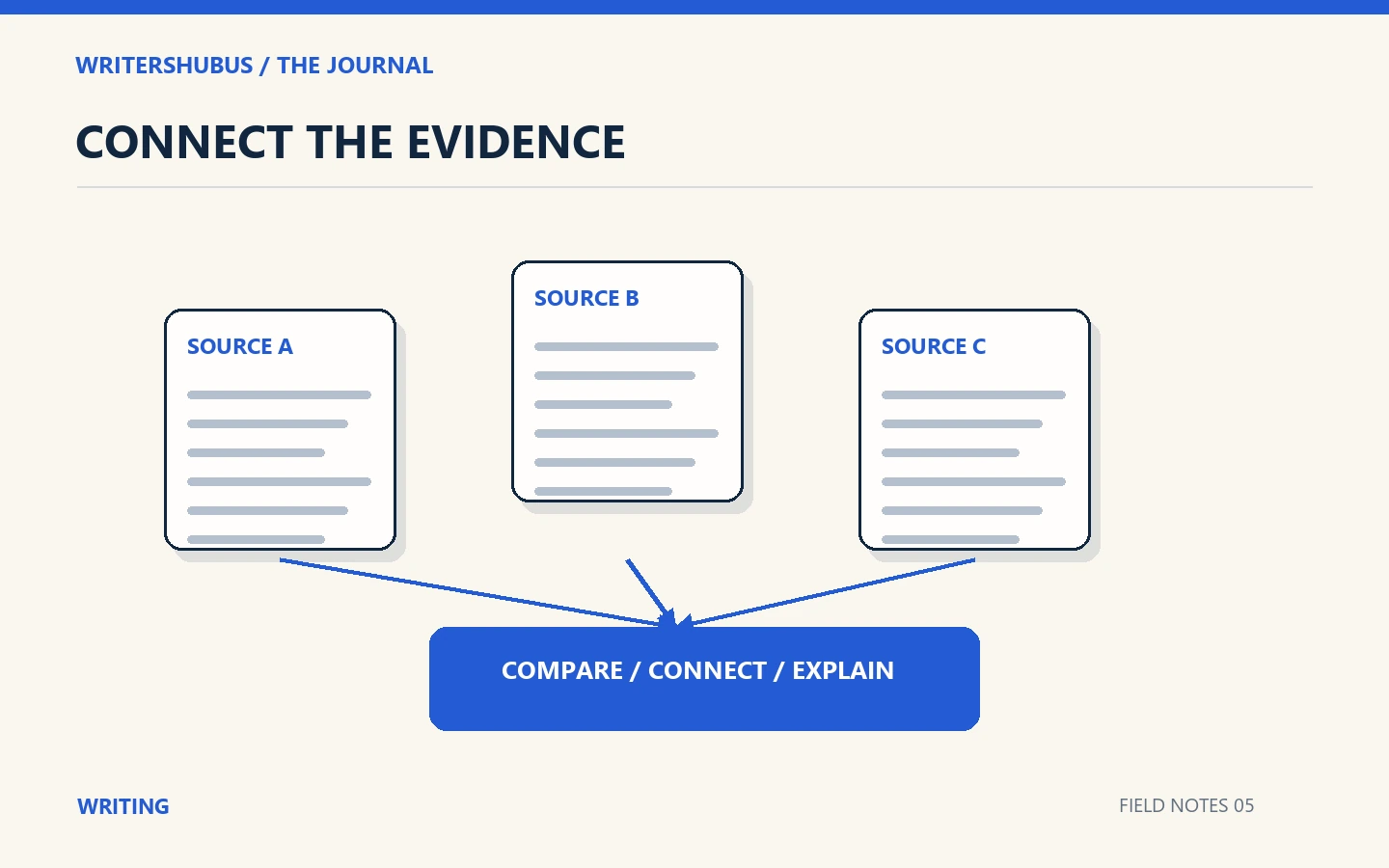
You have found relevant papers, recorded their main points and written a paragraph about each one. The draft is organised, but it still reads like a reading diary. One study follows another without explaining what the collection shows about your research question.
A literature review needs connections. It should help a reader see where findings agree, where explanations differ, what the evidence can establish and which questions remain open. The practical challenge is moving from notes about individual sources to a defensible account of their relationship.
Define the question and the boundaries of the review
Write the question the review serves before deciding how many papers to include. An assigned review may have a specified topic, date range, source type or method. A dissertation or publication may require a more formal review approach. Establish those expectations with the instructions or supervisor.
The University of Wisconsin–Madison Writing Center describes literature reviews as an analysis of published work, including comparison, classification and evaluation. That purpose gives you a useful test: each section should explain something about a body of evidence, not simply report that you read several sources.
Be clear about the kind of review you are undertaking. Do not call an informal selection of papers a systematic review unless you have followed the relevant methodology. A transparent, limited review is more credible than a broad label unsupported by the process.
Record information that makes comparison possible
For each source, capture the research question, setting, approach, evidence, relevant finding and limitations. Include exact citation details and page locations for passages you may use. Keep your interpretation separate from a quotation or the author’s own statement.
Record only the information relevant to your review question. A paper may contain several interesting results while contributing little to the particular comparison you are making. Conversely, a source with a narrow scope can be useful if it directly examines an important condition.
Use a simple matrix rather than relying on memory. The matrix is working material, not necessarily a table for the final manuscript. It should help you notice patterns and return to the original text when a comparison needs checking.
| Source | Question and setting | Relevant evidence | Limitation affecting comparison |
|---|---|---|---|
| Paper A | What was examined, and where? | What finding matters to this review? | What must not be generalised? |
| Paper B | Is the question genuinely comparable? | Does the evidence agree or differ? | Could the design explain the difference? |
| Paper C | Which part of the issue does it address? | What does it add to the pattern? | What remains unmeasured? |
These labels are placeholders for your notes, not fabricated references. Populate the table with sources you have actually read. If a finding is available only through an abstract, record that limitation rather than treating the entire article as reviewed.
Group sources by a meaningful relationship
Try grouping the evidence by theme, method, explanation, population or development over time. Choose the structure that answers your question. A chronological account is useful when a change in the field matters. A thematic structure may work better when several approaches address different parts of one problem.
Give each group a question of its own. “Studies published after 2020” is a date boundary. “How do recent studies measure participation?” identifies a comparison the section can make. The second heading helps you decide what information belongs and what would distract from the point.
Do not force every paper into one category. A source can contribute to more than one theme if its role is clear each time. Avoid repeating its full summary whenever it reappears. Identify the specific finding or method relevant to the current comparison.
Write the pattern before introducing individual papers
Begin a synthesis paragraph with the relationship you want the reader to understand. Then use the relevant sources to support, qualify or complicate it. End by explaining what that relationship means for the review question.
For example, a paragraph might establish that several studies use different definitions of the same outcome. It would then identify those differences and explain why the results cannot be compared as if the outcome were identical. The paragraph’s purpose is the measurement problem, not a complete history of every paper.
This structure does not mean inventing agreement. If the sources do not form a clear pattern, say what differs and why the uncertainty matters. A careful account of inconsistent evidence can be more useful than a confident summary that smooths away important distinctions.
Distinguish disagreement from a different research question
Two studies can appear to conflict while examining different populations, time periods, interventions or outcomes. Before writing “however” between their findings, check whether they are answering the same question at the same level.
Compare what was measured and how. A study of reported satisfaction and a study of observed performance may both concern a learning activity, but they do not measure the same result. Similarly, evidence from one setting may not settle what happens in another.
When the difference cannot be explained from the available information, describe it as unresolved. Do not invent a reason based on the authors’ nationality, a publication year or your preference for one result. Return to the methods and limitations sections for evidence supporting any explanation you propose.
Use a hypothetical synthesis to see the difference
The following scenario is invented to illustrate the writing process. It does not report real findings or provide references that can be cited.
Example
Suppose three papers concern an online discussion activity. One examines how often students post. Another analyses the quality of written responses. A third asks students how useful they found the activity. A source-by-source paragraph would list all three results. A synthesis paragraph would explain that participation, response quality and perceived usefulness are different outcomes, so the papers together provide several perspectives without establishing a single measure of success.
That comparison gives the reader a reason to care about the methods. It also prevents a common overstatement: describing an activity as effective simply because one favourable outcome appeared. Your real review needs the same discipline, with each comparison checked against the actual sources.
Identify gaps without claiming that nothing exists
A gap may concern a setting, a population, an explanation or a method. It may also be a limitation in the evidence you found rather than a complete absence of research. Describe the gap at the level your search can support.
“The studies included in this review do not examine overnight travel” is narrower and easier to support than “No one has studied overnight travel.” The broader statement requires a much stronger search and a clear definition of what counts as relevant research.
Explain why the gap matters. A missing population is not automatically a useful research opportunity. Show how examining it could change understanding of the question, test an assumption or address a practical decision. Keep the proposed contribution realistic for the project’s resources and scope.
Audit the draft for evidence and structure
Read only the section headings and opening sentences. Can you follow the review’s argument? If the outline is mostly author names, reconsider whether the structure makes the relationships visible. Then inspect each source citation and verify that it supports the claim beside it.
Check quotations, paraphrases and reference details against the originals. Avoid adding citations because their titles sound relevant. The Journal’s guide to research notes and accidental plagiarism can support that checking process.
Your final paragraph should explain the state of the evidence and how it connects to your project. Do not introduce an unsupported finding at the end. Leave the reader with a clear account of what is known, what is uncertain and the next question your work can reasonably address.
Get help connecting the evidence you have collected
If your draft is still a series of summaries, choose one theme and build a comparison matrix for it before rewriting the whole review. For help with your search approach, organisation or draft structure, explore WritersHubUS research guidance.
You can also discuss your literature review on WhatsApp. Describe your question, current stage and deadline so the support can focus on the actual difficulty.