
Choosing a research method can feel like choosing a label before you know what your project needs to find out. You may prefer interviews because statistics feels unfamiliar, or a survey because it appears easy to distribute. Either choice can lead to data that does not answer the question you intended to ask.
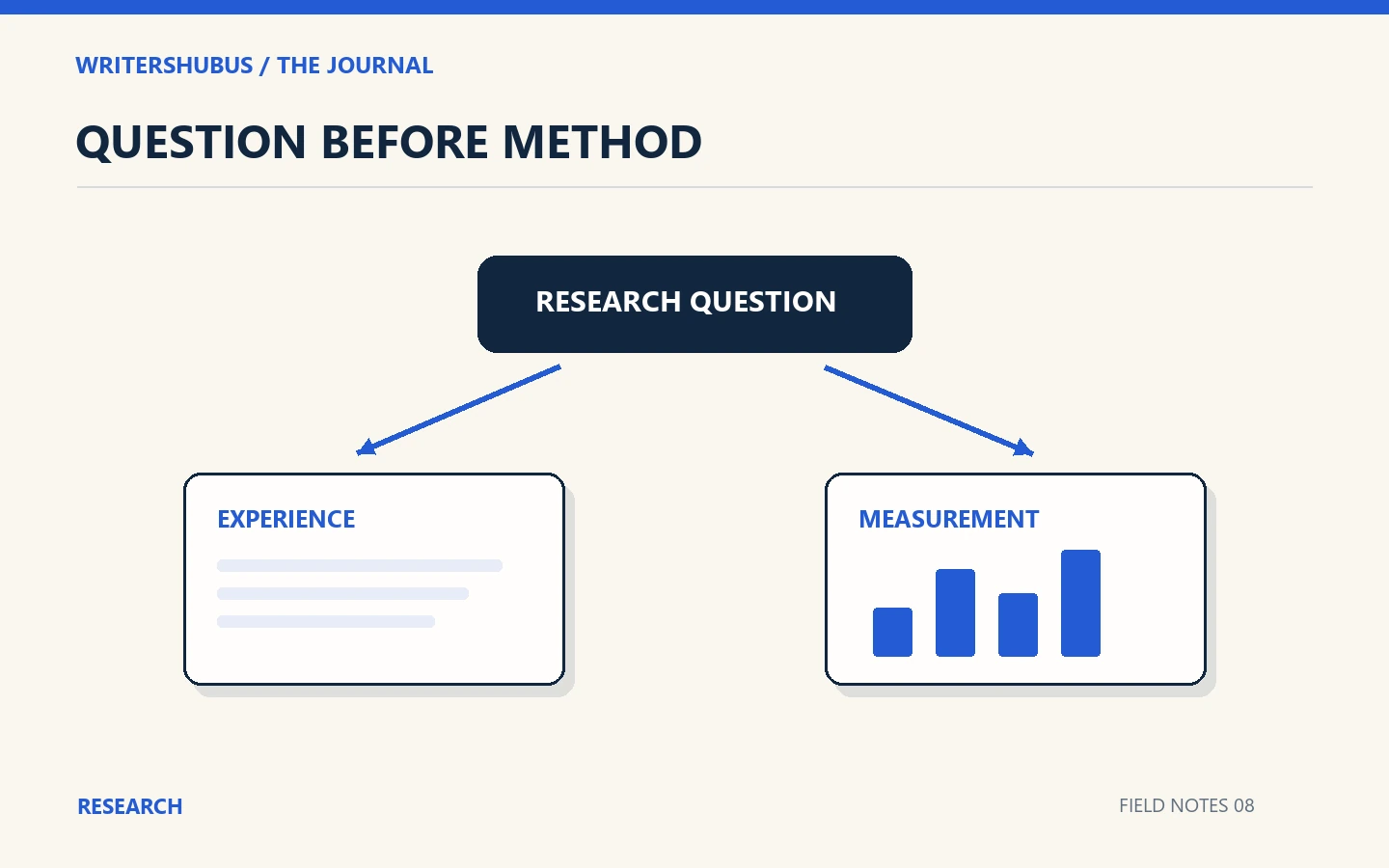
Begin with the decision or explanation the research must support. Then work out what kind of evidence would help. The useful distinction between qualitative and quantitative approaches is how they address a question, not which one sounds more rigorous or is easier to put into a proposal.
Write the question in a form you can investigate
Move beyond a broad topic such as student travel or workplace communication. Ask what specifically you need to understand, among whom and within what setting. A bounded question makes it possible to evaluate whether a method fits.
For example, “What difficulties do first-year student-athletes describe when preparing coursework during travel?” asks about experiences and explanations. “How many students in this programme report missing a planned study session during the last trip?” asks for a count within a defined group and period. These related questions need different evidence.
The University of Southern California’s research methodology guidance connects methods to research questions, data and analytical choices. Use that relationship as the organising principle for your proposal. A familiar method is useful only if it can produce evidence relevant to your question.
Understand what each approach can contribute
Qualitative research can explore meaning, experience, context and processes through material such as interviews, observations or documents. Quantitative research can examine numerical descriptions, comparisons and relationships using appropriately defined measures and analyses.
These are broad descriptions, not rigid lists of permitted activities. The design, sampling and analysis matter within either approach. An interview does not become trustworthy merely because it produces detailed quotations, and a survey does not become representative merely because its answers can be counted.
Mixed methods can combine approaches when the research purpose justifies doing so. It also creates additional work. You need to explain how the forms of evidence relate, how each will be analysed and what their combination contributes. Collecting two types of data without an integration plan can produce two incomplete projects.
Use the same topic to compare different designs
Consider a hypothetical project about students using a campus writing service. No findings are assumed in the examples below. They show how the question changes the design.
| Question | Possible approach | Important design question |
|---|---|---|
| How do students describe deciding whether to seek feedback? | Qualitative interviews | How will participants be selected and accounts analysed? |
| What proportion of this defined group used the service last term? | Quantitative descriptive study | What counts as use, and who is included? |
| Is service use associated with a measured outcome? | Quantitative observational study | What other factors could explain the relationship? |
| How do numerical patterns relate to students’ explanations? | A justified mixed-methods design | How will the two forms of evidence be connected? |
The same service could be studied in several legitimate ways. What changes is the claim the project can support. Choose a design because that claim answers the question, not because another student used the same method successfully.
Define what you would observe or measure
Broad concepts need a clear working meaning. “Engagement”, “success” and “confidence” can refer to several different things. Specify what evidence would count in your project and why that evidence is appropriate.
For a numerical study, you might need a defined response category, observation period and unit of analysis. For a qualitative project, you need a clear account of the experiences, documents or interactions being examined and how you will interpret them. Neither approach benefits from leaving key terms vague.
Avoid inventing a validated measure. If you use an existing instrument, check its source, intended population, permissions and suitability with appropriate guidance. If you design your own questions for a class exercise, describe them accurately and acknowledge their limitations. A professional-looking questionnaire is not automatically an established measurement tool.
Match sampling to the claim you intend to make
Ask who or what the evidence concerns and how you can obtain it. A project using volunteers from one class has a different basis from a carefully designed sample drawn from a wider population. Describe the recruitment process instead of implying that convenience provides representativeness.
For an interview study, explain why the participants can speak to the question. Consider whose experiences would be missing and how that affects interpretation. For a document analysis, identify why those documents were selected and what is outside the collection.
Do not choose a sample size solely because it sounds impressive. The appropriate size depends on the question, design, analysis and practical constraints. Ask your supervisor or a qualified methods adviser to review the reasoning. A copied number from an unrelated project may not serve yours.
Plan analysis before collecting data
Write down what you will do with the evidence after obtaining it. “Analyse the results” is not a sufficient plan. Name the intended process at a level appropriate to your course and experience.
For qualitative material, explain how you will organise, interpret and check the analysis, using the approach the project requires. For numerical material, identify the summaries or comparisons needed and the assumptions that must be considered. Get guidance before committing to an analysis you cannot carry out responsibly.
Thinking about analysis early often reveals a mismatch. If you want to compare groups but your questions do not define those groups, the design needs revision. If your interviews seek detailed experiences but the plan counts only isolated words, ask whether that analysis preserves the meaning you intended to study.
Treat access, consent and privacy as design questions
Permission to contact participants, use institutional data or collect recordings can affect whether a project is feasible. Follow your institution’s ethics and approval requirements before recruitment or collection. Do not assume that a small project, a public social-media post or a classroom assignment is automatically exempt from review.
Collect only information the project needs and use an appropriate storage process. Consider how someone could be identified even after names are removed. In a small team or department, a role description and quotation may reveal the speaker without an explicit name.
These constraints can lead to a better research question. A well-designed analysis of accessible, permitted documents may be more suitable for a short course project than a participant study that cannot be approved and completed within the available time.
Write a justification that names the trade-offs
Explain why the selected method addresses the question, what evidence it will provide and which claims remain outside its reach. A convincing justification acknowledges limitations rather than describing the method as universally best.
An illustrative justification might say that interviews are suitable for exploring how participants describe a decision, while the project will not estimate how common those experiences are across all students. A different project might use a survey to describe responses in a defined group while acknowledging limits in participation and measurement.
Check the wording of the intended conclusion. An observed relationship does not by itself establish that one factor caused another. If causal language appears in your research question, discuss whether the proposed design can support it before collecting data.
Choose the smallest defensible next step
Write your question, proposed evidence, access requirements and analysis plan on one page. Identify the decision you remain unsure about and bring it to your supervisor. This gives the conversation a concrete starting point.
For help narrowing a question, organising a proposal or reviewing the clarity of your methodology draft, visit WritersHubUS research guidance. You can also discuss research planning on WhatsApp. Describe the project stage and deadline while keeping participant information private.