
Being told that your writing may have been generated by AI can be upsetting, especially when you completed the work yourself. You may want to defend every sentence immediately or run the document through several online detectors to find a more reassuring result.
Begin with the actual concern and the institution’s process. A useful response explains how the work developed, provides relevant evidence and addresses the specific questions being asked. It does not depend on finding another automated score or trying to change the document so a detector reads it differently.
Establish what was flagged and who raised the concern
Read the message carefully. Identify the assignment, the passages in question, the stated concern and any response deadline. Check whether the communication is an informal request for discussion or part of a formal academic process.
If the message is unclear, ask for the details needed to respond. You might request the relevant passages, the policy being considered and the next steps. Use a calm, factual tone rather than assuming the outcome has already been decided.
Keep the original communication and any attached report. Do not circulate it publicly or post another person’s comments without permission. The immediate purpose is to understand and respond through the appropriate channel.
Understand the limits of an automated report
Turnitin’s AI Writing Report guidance acknowledges possible misidentification and says its model should not be the sole basis for adverse action against a student. That is an important limitation of the tool, while your institution’s policies determine its review process.
An AI indicator and a similarity report are different types of information. Ask which report or evidence is involved instead of using the terms interchangeably. A highlighted passage may prompt questions, but its meaning needs to be considered alongside the work and the applicable rules.
Do not respond by claiming that every detector is always wrong or that a particular percentage proves your authorship. The stronger response is the evidence of your actual work and a clear account of the process. Another automated score does not replace that account.
Preserve your existing drafts and records
Keep the submitted file, earlier drafts, notes, outlines and source records. Preserve version history where it already exists in your writing tools. Do not manufacture earlier drafts, edit timestamps or create a misleading record after the concern arises.
Gather material that helps explain development. A source note connected to a paragraph, an outline showing a change in the argument or feedback addressed in a later draft can be relevant. The point is to show the relationship between records and the submitted work, not to overwhelm the reader with unrelated files.
| Record | What it may help explain |
|---|---|
| Initial outline | How the question and structure were planned |
| Research notes | Which sources informed particular claims |
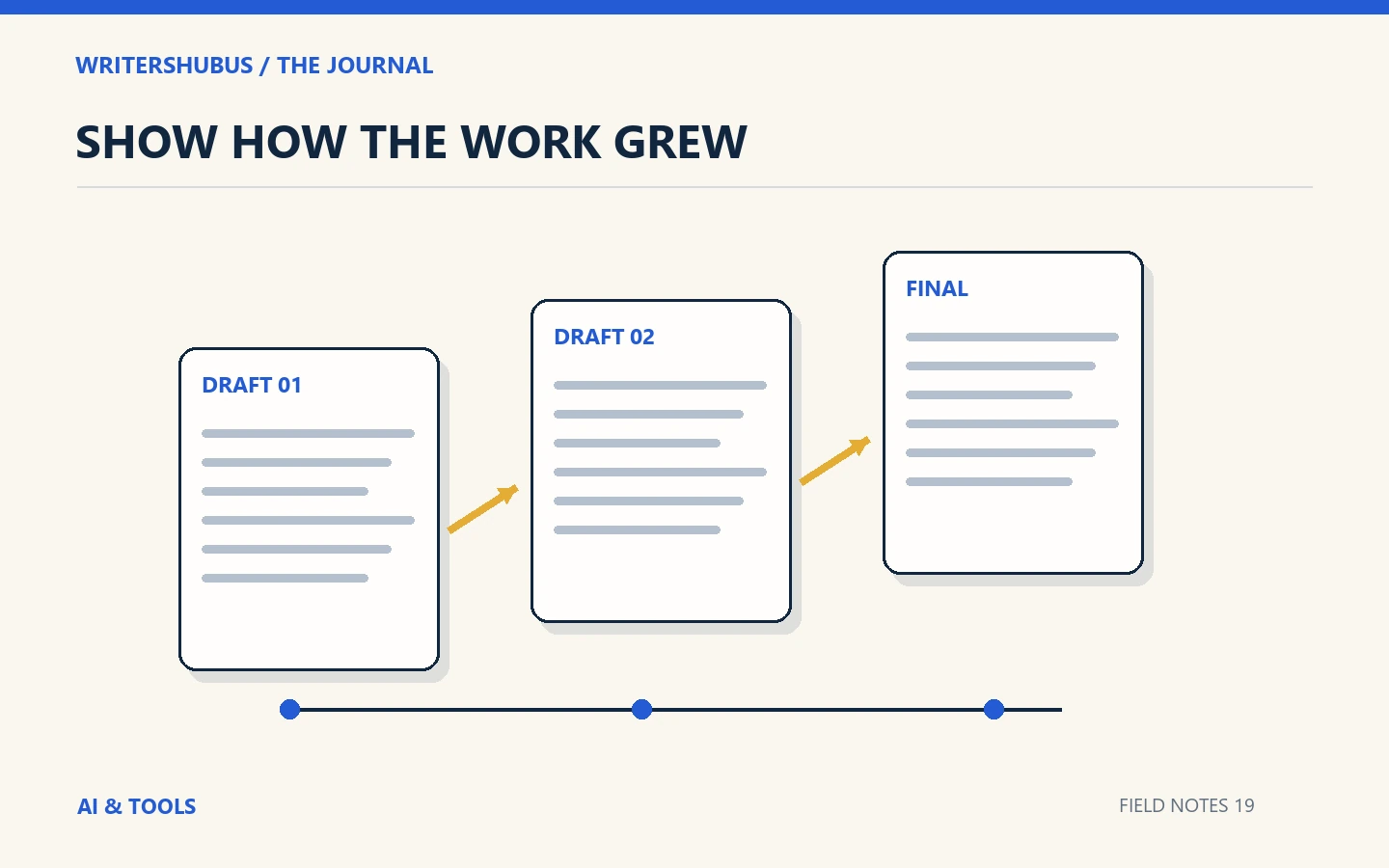
| Successive drafts | How wording and reasoning developed |
| Existing version history | The sequence of recorded edits |
| Feedback and revisions | Why a section changed |
These materials are not guarantees of a particular decision. Their value depends on the concern and institutional process. Keep originals and submit copies only through the accepted channel.
Reconstruct the writing process accurately
Write a short timeline from the records you have. Include when you selected the question, found the main sources, drafted sections and revised the document. Distinguish dates you can confirm from approximate recollections.
Explain the choices behind the work. Why did you organise it that way? Which source changed your view? What did you remove and why? A truthful account can include uncertainty or an imperfect memory. Do not fill gaps with confident details simply because they make the story sound complete.
If you used permitted tools, describe that use accurately. Editing software, translation support, accessibility tools and generative AI may be treated differently under the rules. Avoid broad statements such as “I used nothing” if a more precise account is needed.
Review the relevant policy before making assumptions
Locate the course and institution’s current instructions on academic integrity, AI and review procedures. Check any response deadlines, meeting arrangements and options for support or advice. Follow the official process rather than advice from an unrelated institution.
Ask whether a student adviser, student representative or other support person can assist. Availability and roles vary. Use the institution’s named services to understand what help is permitted and how to request it.
If disability accommodations, language support or another formal arrangement is relevant, discuss it through the appropriate process. You should not have to post personal information publicly to explain the situation. Ask how relevant documentation can be considered securely.
Prepare a concise, evidence-linked response
Address the concern directly, explain your process and identify the records you can provide. Avoid lengthy accusations or speculation about the person reviewing the work. Focus on information that helps them understand what happened.
The following is an illustrative structure. Adapt it truthfully and follow the institution’s instructions.
Example
Hello [name],
Thank you for identifying the concern about [assignment]. I would like to explain how I completed the work and respond to the specific passages being questioned.
I prepared the outline from [accurate description], developed the draft using [accurate source process] and revised it after [actual stage or feedback]. I have retained relevant notes, drafts and existing version history that show this development.
Could you confirm the passages and policy involved, the response deadline and the appropriate way to provide those records? I am available to discuss the argument and my writing process through the course’s review procedure.
[Your name]
Replace the bracketed details before sending. Do not use the template to claim records or actions that do not exist. If some tool use occurred, explain it accurately rather than relying on the sample’s wording to conceal it.
Use a meeting to explain the work, not perform certainty
Before a meeting, review your submitted paper and source notes. Be ready to explain the main argument, important terms and how the evidence supports the conclusion. If a particular sentence is questioned, consider how it developed and whether a source or draft provides context.
Ask for clarification when a question is unclear. If you do not remember a minor detail, say so and offer to check the record. An honest account is more useful than improvising an explanation that later conflicts with your files.
Take notes on what was discussed, what information is requested and what happens next. Where appropriate, confirm your understanding in a short follow-up through the accepted channel. Keep the discussion focused on the relevant work and process.
Avoid actions that create a new problem
Do not rewrite the submitted work through a “humaniser” or similar service to change a detector score. That does not establish how the original work was created and may introduce additional issues. Preserve the version under review.
Avoid uploading the paper and report to multiple unknown services. They may have different privacy, retention or sharing terms. Other people’s comments and identifying information may also be included. Seek approved advice before sharing sensitive material.
Do not buy fabricated drafting evidence or ask someone else to impersonate your writing history. If you made a mistake in following the rules, an accurate account and the official process are the appropriate starting points.
Follow the outcome and keep future records proportionate
Read the decision or next-step communication carefully. If questions remain, use the stated clarification or review route and observe the relevant deadline. Procedures differ, so verify the options at your institution rather than assuming an online example applies.
For future work, keep ordinary notes, drafts and source information as part of a sensible writing routine. You do not need to turn every sentence into a surveillance project. A clear record also helps revision and source checking regardless of whether authorship is questioned.
For support organising your own draft, understanding feedback or explaining your argument clearly, see WritersHubUS writing and editing support. You can ask about writing-process support on WhatsApp. Formal decisions and reviews remain with your institution, and no editing service can promise a particular outcome.