
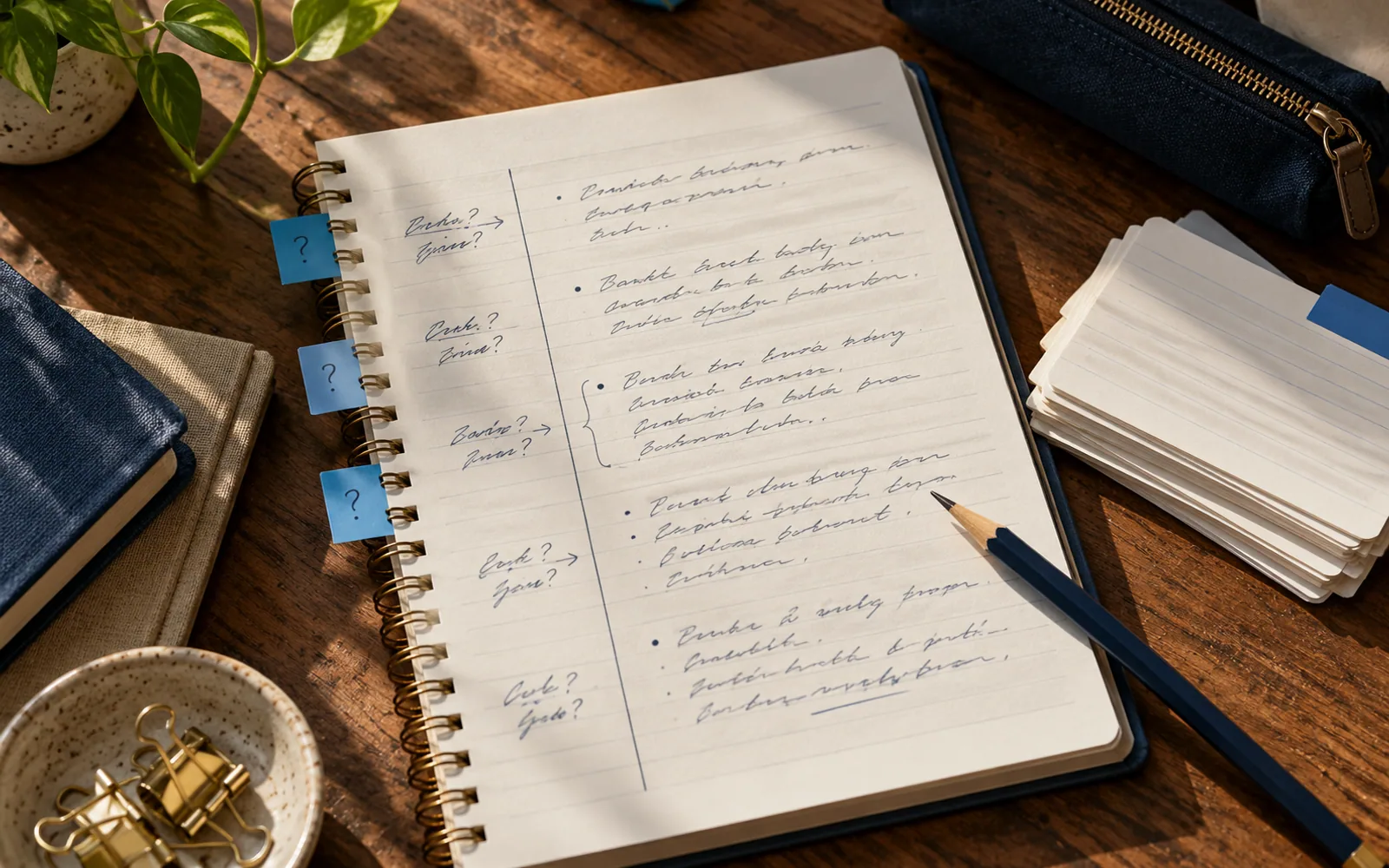
Notes are useful only when they help you return to an idea later. A page filled with every sentence on a slide can look complete and still leave you with nothing to study from. The aim is not to create a transcript. It is to leave yourself a trail back to the reasoning, examples, and questions that matter.
Decide what the notes need to do
During class, your job is to capture the structure of an idea: the main claim, the explanation, an example, and anything the instructor signals as important. You do not need full sentences for everything. Short phrases, arrows, a small diagram, or a comparison can preserve the connection between ideas better than copying every word.
When a point feels unclear, mark it with a question instead of stopping the entire lecture to fix it. A question mark in the margin is an instruction to your future self: return here before the topic becomes unfamiliar.
Add a five-minute finish
The most valuable part of note-taking often happens after class. Within a day, read your notes once and add three things: a one- or two-sentence summary, a list of terms you cannot yet explain, and one question you could answer without looking at the page. This turns notes from storage into the start of retrieval practice.
For example, after a psychology lecture you might write: “This section explains why correlation does not prove causation.” Then ask: “What third variable could make two things appear related?” When you can answer that question without your notes, you know the idea is becoming yours.
Use notes to make practice, not rereading the only plan
Before an exam, cover one section and explain it aloud, write a mini-outline from memory, or make one practice question per page. Check the notes afterward and label what you missed. That small feedback loop tells you where to spend the next study block.
You can also keep a running “connections” section. Each week, write one way the new material relates to an earlier unit, a real example, or a question from another class. Connections make review less like memorizing isolated facts.
Make the system small enough to keep
Choose one format you will actually use: a notebook with a summary box, a document with headings, or simple paper divided into ideas, examples, and questions. Consistency is more useful than a complicated method you abandon after two lectures.
Start with one class
For your next class, do not try to redesign every old page. Take notes normally, then spend five minutes adding a summary, two questions, and one next action. Repeat for a week. At the end, use those questions as the first ten minutes of your next study session.
Separate facts from your thinking
A helpful note page makes it easy to see what came from the instructor and what came from you. Use a small symbol, a different indentation, or a margin label for your own examples and questions. Later, this lets you spot the difference between a definition you need to learn and an explanation you need to practice.
When a class includes formulas, processes, or arguments, do not only record the final answer. Write the step where the choice changed: why this formula applies, why this source is credible, or why the author moves from evidence to a conclusion. Those decision points are usually what an exam or assignment asks you to understand.
Review across the week
At the end of the week, skim your summaries and choose three questions from different class meetings. Answer them on a blank page before checking your notes. The gaps you find are useful information, not evidence that the notes failed. Update the question, look for the missing connection, and return to it in the next short study block. This keeps review spread out instead of forcing everything into one late-night session.