
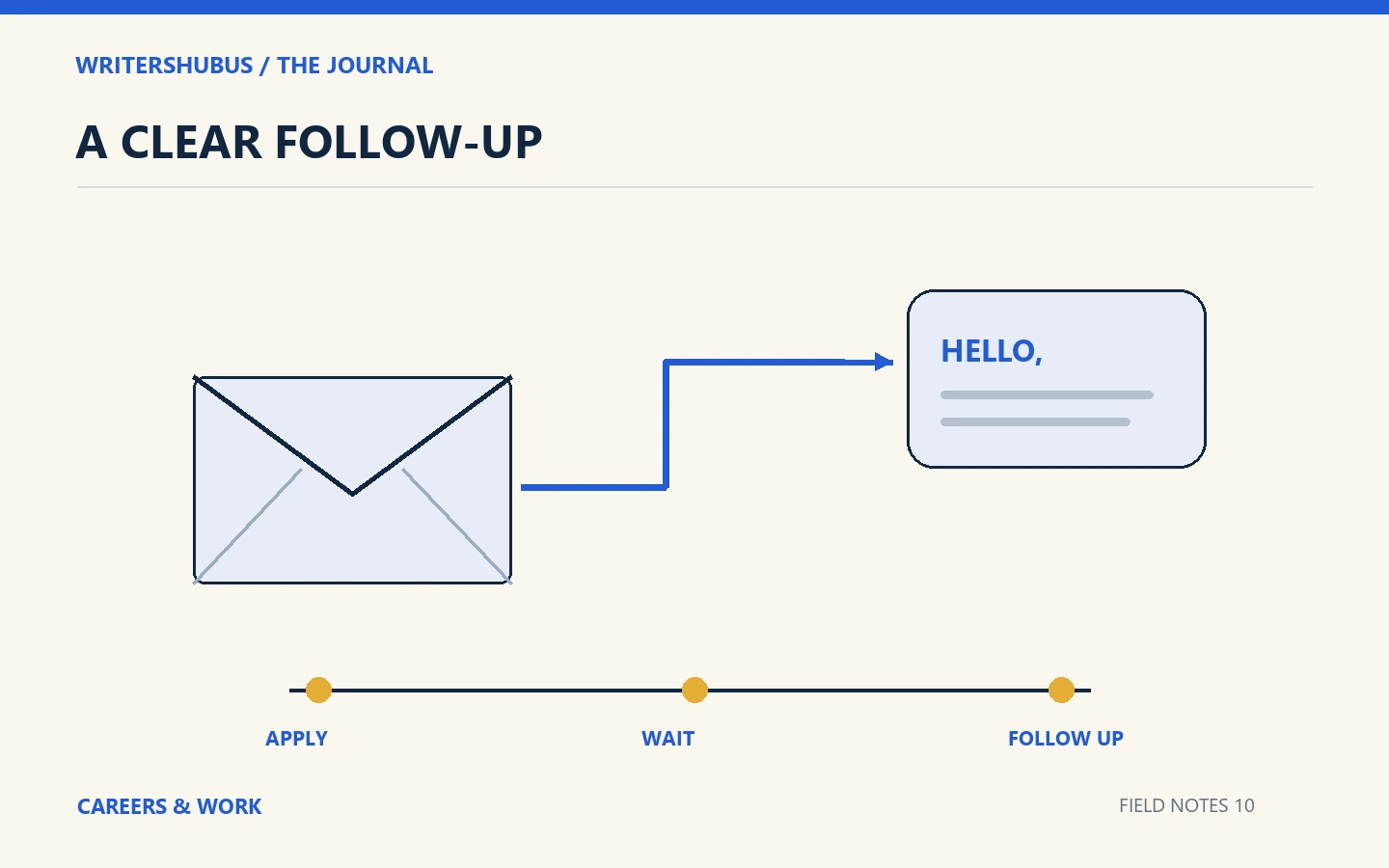
You submitted the application, checked the confirmation and waited. Now you are unsure whether a follow-up would show interest or create an irritation. After an interview, the uncertainty can feel even stronger because you have spoken to real people and expected a decision.
A useful follow-up is a short, relevant message sent through an appropriate channel. It should identify the application, recognise any stated timeline and make it easy to respond. It cannot force a decision, and repeated messages do not necessarily add useful information.
Identify which stage you are following up on
Different stages call for different messages. Checking whether an application was received is not the same as thanking an interviewer or asking about a delayed decision. Decide the purpose before choosing the wording.
Review the advertisement, confirmation email, recruitment portal and your notes. Look for a timeline, contact person and any request not to contact the team. If the employer has already explained when applicants will hear back, use that information before inventing a deadline of your own.
The Virginia Tech after-interview guide includes guidance and examples for professional job-search communication. Use sample messages as a starting point, then adapt them to the actual stage and instructions in your application.
Check receipt before asking for a decision
If you received a submission confirmation, save it. If the application portal shows a status, read what the employer says that status means. A label such as “received” may simply confirm that the system accepted your documents.
When no confirmation appears and the application deadline is near, a factual receipt enquiry may be appropriate through the designated support route. State what you submitted, when and the role reference. Avoid resubmitting through several channels unless instructed, since duplicate applications can create confusion.
Do not include passwords, identity documents or a full application packet in an unsolicited follow-up. A role title and application reference may be enough to locate the record. If more information is requested, verify the recipient and use the employer’s accepted process.
Choose timing from the information you have
There is no single waiting period that fits every employer. Recruitment schedules depend on the role, application closing date, interview process and organisation. The most relevant timeline is the one the employer provided.
If a stated date passes, allow for the possibility of a reasonable delay and decide whether a concise enquiry would help. If no timeline was given, avoid sending a status message immediately after applying. Use judgment based on the recruitment process and any published instructions.
After an interview, a brief thank-you message and a later status enquiry have different purposes. The first acknowledges the conversation and can reinforce a relevant point. The second asks for an update when the expected process is unclear or delayed. Combining them carelessly can make a thank-you sound like an immediate demand for a decision.
Write a subject line that identifies the role
Make the message easy to locate. Include the position title and, if available, the job reference. A vague subject such as “Following up” may be difficult to distinguish from dozens of unrelated messages.
Use the existing email thread when that is appropriate and the recipient remains correct. Do not reply to an automated no-reply address expecting a recruiter to see it. If the employer supplies a particular contact route, follow it.
Check the recipient’s name and title. An incorrect greeting can distract from an otherwise careful message. If the message goes to a recruitment team rather than one named person, address that team plainly.
Keep an application follow-up focused
An application follow-up usually needs the role, application date, continued interest and a polite question about the process. Add new material only if it is relevant and welcome. Repeating the entire cover letter creates more reading without answering the status question.
The following is a reusable structure. Replace the bracketed details and remove anything that does not match your situation.
Example
Subject: [Position title] application — [your name]
Hello [name or recruitment team],
I applied for the [position title and reference] role on [date]. I remain interested in the opportunity, particularly [one genuine connection to the work].
Could you let me know whether there is an updated timeline for the next stage? I am happy to provide any additional information requested through your application process.
Thank you for your time.
[Your name]
This message is intentionally limited. Do not add claims such as “I am your strongest candidate” or an invented competing offer. Interest is credible when expressed through accurate, relevant information.
Make an interview thank-you specific
After an interview, mention one substantive point from the conversation. That might be a responsibility, a challenge the team described or a connection between your experience and the role. Keep it brief and avoid restating every answer you gave.
If you need to clarify an important response, do so carefully. A short correction of a factual mistake can be useful. A long replacement interview sent by email is less likely to help the reader understand the next step.
An illustrative sentence could read: “Our discussion about maintaining accurate programme records reinforced my interest in the role. The coordination example we discussed is work I would be keen to build on.” Use a detail that actually arose, not a generic sentence pretending to be personalised.
Ask about a delayed decision without assigning blame
When the expected date has passed, refer to it neutrally. You can say the team had indicated an update around a particular date and ask whether the schedule has changed. Avoid assuming that silence means rejection, disorganisation or disrespect.
| Situation | Useful focus |
|---|---|
| Stated timeline has passed | Ask whether there is an updated schedule |
| You have a genuine competing deadline | State the real deadline and ask what the employer can confirm |
| You must correct a material error | Explain the correction clearly and briefly |
| You received a rejection | Respect the decision and ask for feedback only where appropriate |
If you have another offer, describe it truthfully and avoid using it as a threat. The employer may be unable to accelerate its process. Decide what you will do if no answer arrives by your own deadline rather than relying on an uncertain response.
Keep a record and know when to stop
Track the application date, relevant contact, expected update and any follow-up sent. This prevents accidental duplication and makes it easier to continue the broader job search. Record facts rather than interpreting each silence as a personal judgment.
If a reasonable enquiry receives no response, repeated daily messages are unlikely to improve the communication. Respect explicit instructions and avoid contacting unrelated employees to apply pressure. Continue applying elsewhere while leaving the existing application open if it remains active.
When a rejection arrives, read any stated policy about feedback. A brief, gracious reply can preserve a professional relationship, but the employer may not provide individual comments. Do not treat a lack of feedback as evidence that you are unqualified for other roles.
Check the message once before sending
Confirm that the question has not already been answered in the latest email or portal update. Remove an attachment the recipient did not request and check that the thread does not expose another employer’s information. Read the message as a busy recipient would: the role, reason for contact and requested update should be apparent without opening several documents. Then send it once through the appropriate route and record the date.
Review the whole application, not only the follow-up
A follow-up works best as part of a clear, truthful application. Check that your résumé, cover letter and interview examples communicate the same experience. If you repeatedly struggle to explain your fit, improving those materials may be more useful than rewriting another status email.
For feedback on your application wording or interview preparation, visit WritersHubUS career and application support. You can also message WritersHubUS on WhatsApp. Describe the stage you have reached and the kind of assistance you need. Keep employer and applicant information limited to what is necessary for the enquiry.