
You used an AI tool while working on an assignment, and now the instructions ask you to explain that use. “AI helped me” is too vague. A bibliography entry alone may not describe what changed in the work. At the same time, you do not need to invent a formal declaration that your instructor never requested.
Start with the course rules and a factual record of what happened. Permission, acknowledgement, citation and verification answer different questions. A clear account identifies the tool’s role and leaves the reader able to understand the work you completed yourself.
Check permission before choosing a disclosure format
Read the assignment instructions and the course policy. Permission may differ between brainstorming, editing, translation, calculation, generated text and other uses. A tool being available does not establish that a particular use is allowed.
If the rules are unclear, ask the instructor about the specific action. “May I use an AI tool to suggest alternative headings for an outline I wrote?” is easier to answer than “Can I use AI?” Keep the response through the course’s accepted communication channel.
Acknowledging a use does not make a prohibited action permitted. If you have already used a tool in a way that may conflict with the instructions, seek clarification honestly. Do not attempt to solve the problem by disguising the output or omitting the record.
Separate acknowledgement from citation
An acknowledgement describes how a tool contributed to the work or process. A citation identifies material used as a source according to the applicable style and instructions. Depending on the situation, you may need one, both or a different form required by the institution.
The MLA guidance on describing AI use addresses documenting a tool’s role. APA’s generative-AI reference guidance discusses citation conventions. Consult the current version of the relevant guidance, then follow the requirements for your actual assignment.
Do not assume one universal sentence satisfies every course or publication. The required detail can depend on how the tool was used, what material appears in the submitted work and whether an interaction record must be provided.
Keep a simple record while working
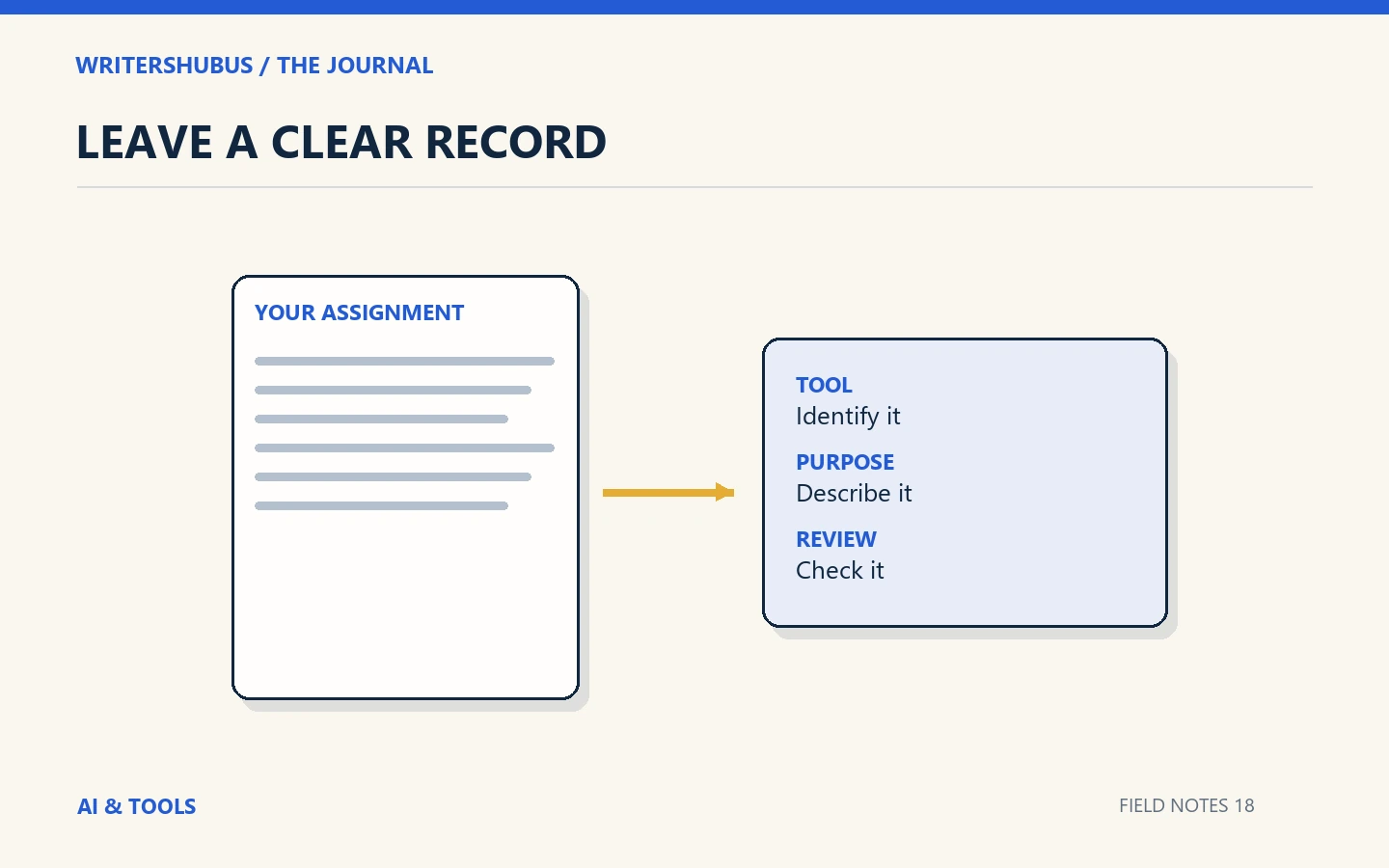
Record the tool, relevant date, purpose, input category and what you did with the output. You may need a model or version identifier if the instructions request one and it is available. Do not invent that information when the interface does not show it.
Save the relevant interaction only through an appropriate process and where permitted. Avoid creating a publicly accessible conversation link containing private coursework, other people’s information or unpublished research. If evidence must be submitted, ask which secure method the instructor expects.
| Record field | A useful question |
|---|---|
| Tool and date | What service did you use, and when? |
| Purpose | What task did you ask it to perform? |
| Material supplied | What kind of information did you enter? |
| Output used | Which suggestions or material affected the work? |
| Your review | What did you check, change or reject? |
This working record should be accurate enough to support a concise final explanation. It does not need to become a second essay unless the assignment specifically requires a detailed process report.
Describe the action instead of the intention
“I used AI responsibly” is an intention or judgment. “I asked the tool to suggest headings for my outline and selected two after comparing them with the assignment brief” describes an action. The second account gives the reader information they can understand.
Be precise about the scope. If the tool rewrote several paragraphs, do not describe the use only as spell-checking. If you rejected all generated content but used the exchange to identify a question for further reading, explain that limited role where disclosure is required.
Distinguish your work from tool output without overstating either. You remain responsible for the submitted material under the applicable course rules. A disclosure should not transfer accountability to the service or imply that generated content has been independently verified merely because you read it.
Adapt an example to the use that actually occurred
The following examples illustrate descriptions, not universally approved statements. Use them only when the described activity was allowed and accurately matches your process.
Example
Outline feedback: I used an AI tool to suggest alternative section headings for an outline I had written. I compared the suggestions with the assignment criteria and revised the final structure myself. No generated paragraphs were included.
Language feedback: I used an AI tool to identify sentences in my draft that might be unclear. I reviewed each suggestion and made selected changes after checking that the meaning remained consistent with my argument.
Practice questions: I used an AI tool to generate practice questions while revising. I checked their answers against the course materials. The submitted assignment was completed separately under the course instructions.
These descriptions omit tool details that may be required in a real submission. Add the actual service, dates and other requested information. Do not copy the examples as a convenient account if your use was different.
Check every factual contribution independently
If output introduces a fact, quotation, reference or calculation, inspect the appropriate original evidence. A plausible reference can still be wrong or nonexistent. A working link can lead to a real paper that does not support the claim attached to it.
Read the source itself before using it. Record where it supports the relevant statement and whether any limitation changes the interpretation. The Journal’s AI citation-verification guide explains a practical checking sequence.
For calculations or code, use the checking methods appropriate to the task. Do not describe an output as validated solely because the tool repeated the same answer. If you cannot assess a technical result reliably, ask for qualified guidance before relying on it.
Place the explanation where the instructions require
The course may ask for a declaration, appendix, methods statement, citation or process reflection. Use that location and format. If no location is specified but acknowledgement is required, ask rather than scattering inconsistent statements through the document.
Keep the explanation proportionate and readable. A short description can be sufficient when the role was narrow, while substantial use may require a more detailed record. The goal is an accurate account, not a defensive paragraph full of claims that no one can verify.
If the final work includes AI-generated material that requires citation, apply the current relevant style carefully. Confirm what the style asks you to identify, and do not fabricate a retrievable URL, author name or version to fill an example format.
Protect privacy when documenting the interaction
Disclosure does not require careless exposure of information. Review any record for names, grades, personal identifiers, participant details or confidential content. Follow the institution’s directions for retaining or submitting evidence.
If you entered information you should not have shared, follow the appropriate reporting or support process. Avoid assuming that deleting a chat automatically resolves every issue. The required response depends on the information, service and institutional rules.
Before your next use, decide whether the material can be supplied to that tool at all. A clearer permission decision at the start is easier than trying to reconstruct an appropriate record after submission.
Update the account when your process changes
A statement written early in the project can become inaccurate after later revisions. If you use another tool, change the purpose of a session or retain generated material you initially planned to discard, update the working record. Review the final account against the submitted version, not only the first draft. When several tools were involved, describe their separate roles rather than attributing the entire process to whichever one you remember most easily.
Leave a truthful account of your work
Before submitting, compare the explanation with your drafts and interaction record. Check that it identifies the role accurately, follows the assignment policy and does not claim verification you did not perform. Keep the language straightforward.
For support with understanding an assignment brief, organising your own argument or improving a draft’s clarity, visit WritersHubUS writing and editing support. You can ask about draft feedback on WhatsApp. Explain the course’s permitted support so any assistance fits those requirements.