
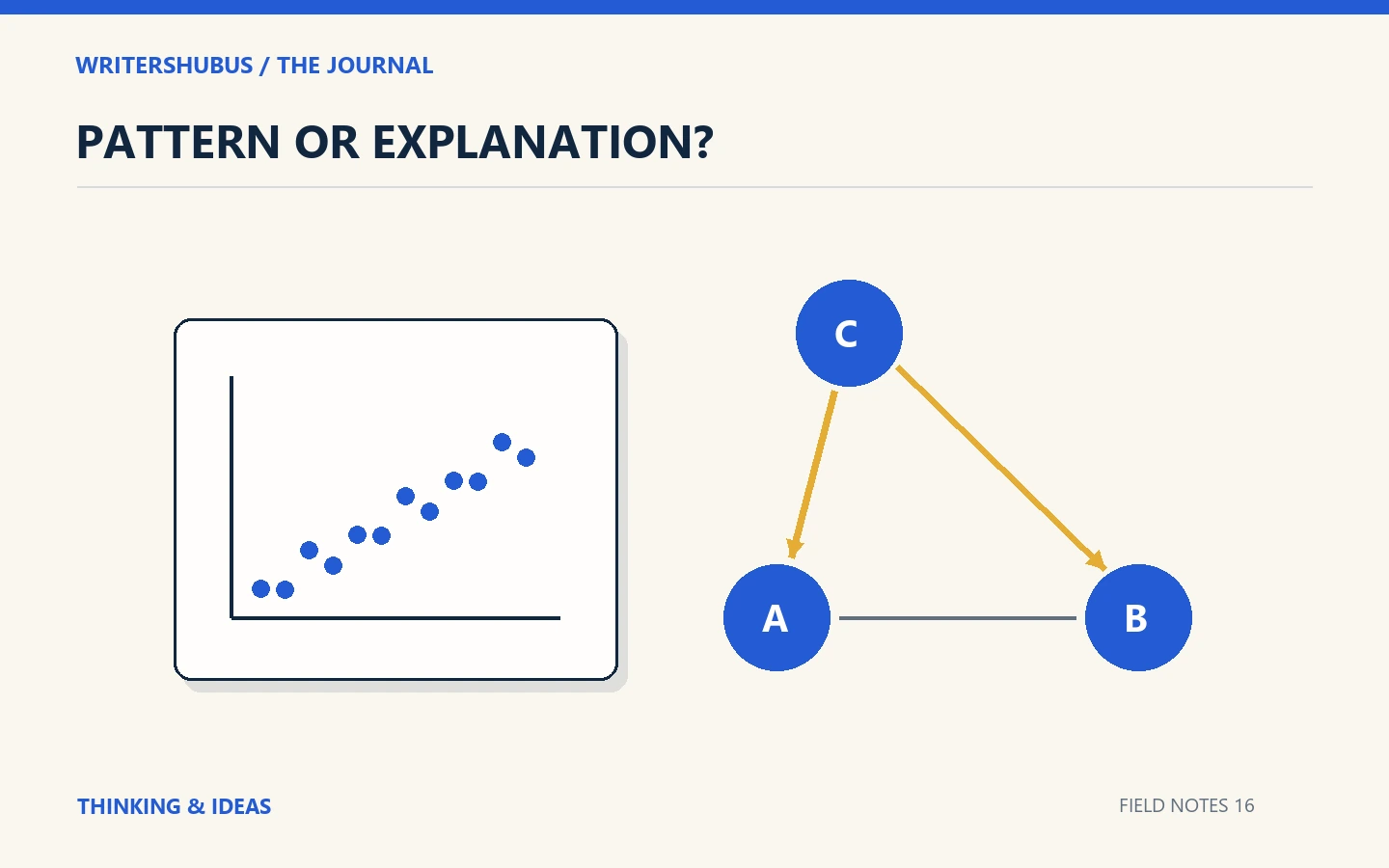
A headline says students who use a particular tool receive higher grades. A post says people with one habit earn more. A graph shows two lines moving together and a caption announces that one caused the other.
Each claim may describe a real relationship, but the explanation needs another step. Before deciding what caused an outcome, ask how the evidence was collected, what else differs and whether the proposed direction makes sense. This habit helps with coursework, news and everyday decisions about advice.
Separate the pattern from the explanation
An association is a pattern in which variables are related in the data being examined. A causal claim says that changing one factor produces a change in another under the relevant conditions. Observing a pattern does not, by itself, establish that explanation.
OpenStax’s explanation of research findings distinguishes association from causation and explains how a shared influence can produce a pattern. Use the distinction to ask better questions. It is not a reason to dismiss every observational study or to assume that causation can never be investigated.
First, rewrite the claim at the level the evidence clearly supports. “In this dataset, students using the tool had higher recorded scores” describes a pattern. “The tool raises grades” adds a causal interpretation. Identifying that added step makes the rest of the evaluation more precise.
Ask what was measured and in whom
Find the variables, population, period and unit of analysis. “Success” might mean a test score, course completion, income or a self-reported feeling. A relationship cannot be interpreted well when the outcome is left vague.
Check whether the data concern individuals, groups, institutions or regions. A pattern across universities does not automatically describe the relationship within each university or for each student. The level at which information was collected affects what you can conclude.
Also check the comparison. People who chose a service may differ from people who did not. Countries, schools and workplaces can differ in many ways at once. The fact that the graph has two labelled variables does not mean only two relevant factors exist.
Consider a shared influence
A third factor may influence both variables. In a hypothetical study, students who attend an optional review session may also have more available time, stronger prior preparation or a different level of motivation. Those differences could help explain their later scores.
This does not prove that the review session has no effect. It means the observed comparison does not isolate its effect on its own. The correct response is to examine how the study addresses other explanations, not to replace one unsupported conclusion with the opposite unsupported conclusion.
List plausible alternatives that arise from the actual setting. Do not invent an unlimited number of remote possibilities to avoid considering evidence. Useful alternatives are relevant enough that the design or analysis should address them, or that the authors should acknowledge them as limitations.
Check whether the direction could run the other way
Sometimes an outcome can influence the factor being described as its cause. A hypothetical survey might find that people who feel confident participate more in a class. Participation could affect confidence, confidence could affect participation, or both could change together through other influences.
Ask when each measure was collected. A one-time survey may not establish which came first. A sequence over time can provide additional information, but timing alone does not remove every competing explanation.
Watch for wording that silently changes direction. “Students who are doing well report using the resource” does not automatically justify “using the resource makes students do well.” Return to the design before accepting the advice attached to the finding.
Look at how the comparison was created
An experiment, a natural experiment and an observational analysis can provide different kinds of evidence. The details matter. Random assignment, when appropriately used, can help address differences between groups, but it is not a magic label that removes all questions about implementation or interpretation.
Ask what was assigned, what participants actually received and how outcomes were measured. Consider missing data, departures from the planned process and whether the comparison remains meaningful. Read the study’s limitations rather than evaluating it through one design word in the abstract.
For an observational study, inspect the authors’ reasoning about alternative explanations and the assumptions required for a causal interpretation. If you lack the methods background to evaluate that reasoning, use a qualified explanation and keep your summary appropriately cautious.
Use a worked claim check
The following scenario is invented. It demonstrates questions to ask and does not report a real research finding.
Example
A fictional campus survey finds that students who use a planner report submitting more work on time. A promotional post concludes that the planner caused the improvement.
Before accepting that conclusion, ask whether planner users already had different study habits, whether both measures were self-reported, which students answered the survey and whether the use of the planner preceded the submissions. The relationship could be worth investigating, but the survey description alone does not isolate the planner’s effect.
Notice that the useful conclusion is limited. You do not have to call the planner useless or claim that every user report is false. You can say the evidence described does not support the strength of the causal claim being made.
Do not confuse statistical evidence with practical importance
A reported statistical result needs context. Ask about the size of the relationship, uncertainty, measurement and relevance to the decision. A small difference can be reported precisely while still being of limited practical use in your situation.
Avoid treating a correlation coefficient as a universal score for quality or causality. Its meaning depends on the data and the kind of relationship being examined. A scatterplot or fuller description may reveal features that a single summary number hides.
Likewise, failure to find a particular statistical result does not automatically prove no relationship exists. The design, amount of information and uncertainty matter. If the technical interpretation is central to your assignment, consult the course material or a qualified methods adviser.
Rewrite the claim so it matches the evidence
Choose verbs that reflect what was established. “Was associated with”, “was reported alongside” or “differed between these groups” may be appropriate when the evidence describes a relationship. Use stronger causal wording only when the design and reasoning support it.
| Overstated wording | A question before accepting it |
|---|---|
| This habit causes higher grades | Was the effect separated from prior preparation and other differences? |
| This policy solved the problem | What comparison supports that explanation? |
| These two trends prove the claim | Could a shared influence or timing explain both? |
| It worked for this group, so it will work for everyone | Does the evidence apply to the new population and setting? |
When sharing a finding, retain the population and limitation that change its meaning. A cautious sentence is not weak if it accurately describes the evidence. It gives the reader a better basis for judgment.
Ask whether the evidence supports the action being recommended
Even a credible causal finding may not settle your own decision. Check whether the studied setting, available resources and outcome match the situation where you plan to act. An intervention examined over a full term may not have the same meaning when someone offers it as a solution for tomorrow’s deadline.
Consider what the recommendation would cost in time, money or displaced effort. The source may establish one outcome while leaving other consequences unmeasured. Write down the additional assumptions needed to move from the finding to the proposed action. This makes the decision clearer without dismissing useful evidence simply because it is incomplete.
Apply the habit to a real decision
Choose one claim you have recently encountered. Identify the original evidence, the relationship observed and the additional causal interpretation. Write one plausible alternative explanation and check whether the source addresses it.
For help understanding a research argument, interpreting a source or improving the clarity of a draft, visit WritersHubUS research guidance. You can discuss your research question on WhatsApp. Bring the actual source and the point you need to understand, rather than relying only on the headline.