
An email arrives inviting you to submit a paper. It praises your expertise, promises a quick decision and links to a journal with an impressive name. The invitation may be relevant, but the message itself is not enough to establish that the journal is a suitable place for your work.
Before submitting, investigate the journal as a publication and as a service provider. Check who operates it, how review works, what publication costs and whether its audience matches the research. The goal is to make an informed submission decision, not to judge credibility from a polished homepage or an alarming email alone.
Separate suitability from trustworthiness
A legitimate journal can still be a poor fit for your paper. Its scope may not include your subject, its audience may be different or its article format may not suit the work. Begin by reading the aims and scope, author instructions and several recent papers.
Look for a meaningful relationship between the published work and your manuscript. A journal that claims to accept almost every subject requires careful evaluation of its editorial structure. However, breadth alone does not establish misconduct. Evaluate the actual information and practices rather than treating one feature as a verdict.
For an early-career researcher, discuss the shortlist with a supervisor, subject librarian or experienced colleague. Ask for reasons behind a recommendation. “People in our field read this journal” is useful context when supported by examples, but it does not replace checking the journal’s current policies.
Establish the journal’s exact identity
Record its full title, publisher, official website and identifying details. Similar titles and copied branding can make a search result look more familiar than it is. Follow links carefully and compare the address with a reliable library record or the publisher’s established site.
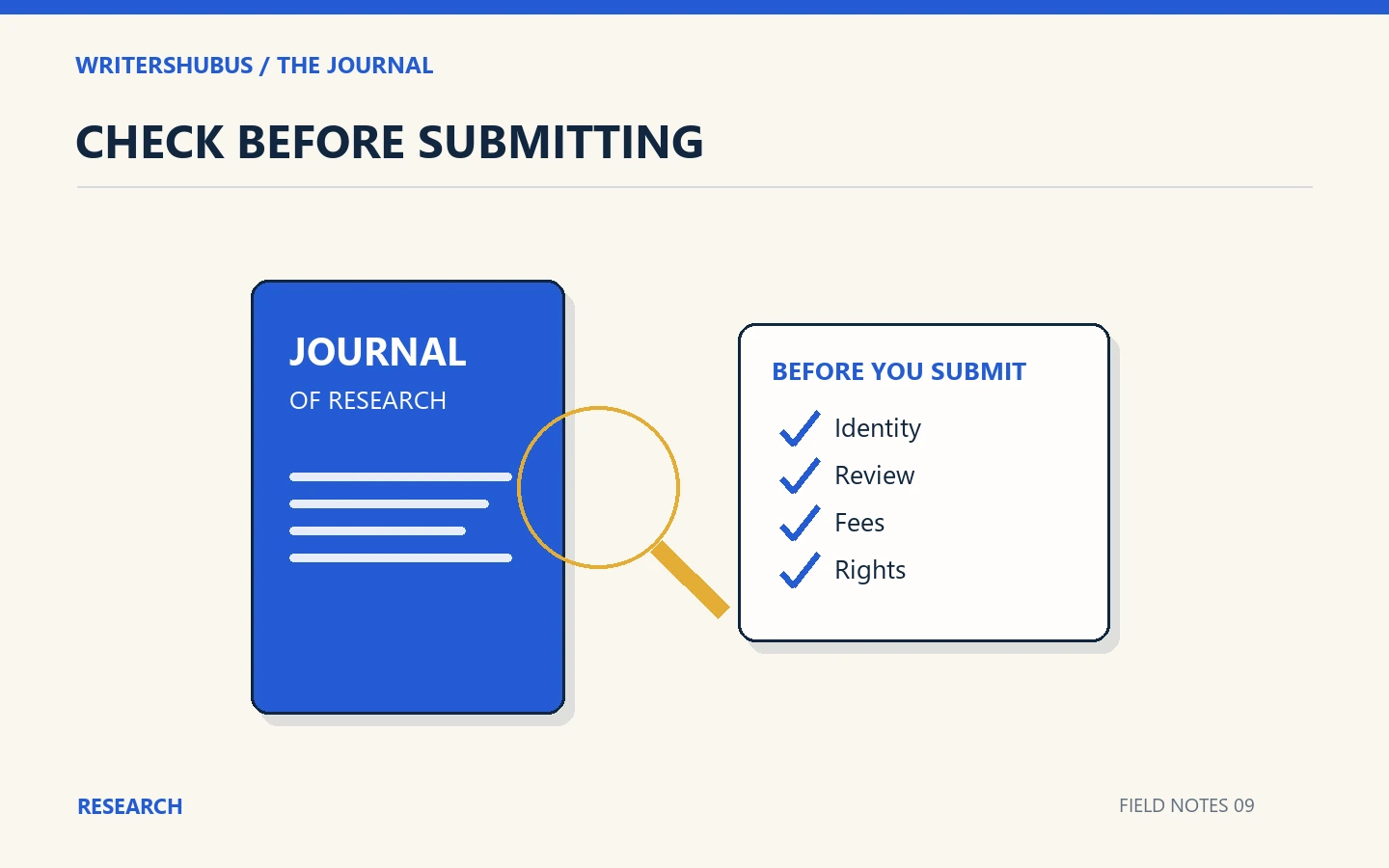
The Think. Check. Submit. journal checklist provides a structured starting point for evaluating publishers and journals. It prompts researchers to inspect identity, peer review, fees and related publication practices. Work through the questions using evidence you can locate, rather than ticking boxes based on promotional wording.
If an invitation directs you to a submission portal, confirm that the portal belongs to the journal you researched. Avoid uploading an unpublished manuscript simply to discover what is behind the next screen. Submission can involve agreements, licences or policies you should understand first.
Investigate who is responsible for editorial decisions
Look for named editors and a clear explanation of their roles. Where appropriate, check professional affiliations through independent institutional profiles. An unfamiliar name is not a problem by itself, but an unverified list does not establish an active editorial board.
Consider whether the editors’ expertise is relevant to the journal’s scope. If a claim appears inconsistent, seek clarification using a verified contact route. Do not accuse individuals publicly because a website is incomplete or because you cannot immediately confirm a detail.
Keep a short record of what you found. The question is whether responsibility is identifiable and the claims are coherent. A journal may be new, small or based outside a familiar publishing market and still operate responsibly. Geography, language and visual style are poor substitutes for examining practice.
Read how review and publication are described
Find the peer-review policy and identify what is promised. Does the journal explain the review process, editorial decisions, revisions and conflicts of interest? Is there a distinction between an initial editorial check and external review?
Treat a guarantee of acceptance with caution, especially when it arrives before anyone has evaluated the manuscript. A fast initial decision and a guaranteed favourable review are different claims. Ask what a stated time frame covers instead of assuming that every quick process is improper or every lengthy process is rigorous.
Examine a few published articles for the information the journal says it provides. Look for publication histories or correction notices where relevant. One error does not prove a journal is untrustworthy, but a repeated mismatch between policy and practice deserves further investigation.
Understand every charge before submitting
Locate the publication fees and any submission, page, colour, editing or other charges. Establish the currency, when payment becomes due, whether taxes apply and what happens if the paper is withdrawn or declined. Read waiver information if it matters to your situation.
Charging a publication fee does not by itself make a journal illegitimate. The important questions are transparency, value, consent and whether the claimed editorial process is genuine. Equally, describing publication as free does not guarantee suitable review or a credible audience.
| Cost question | What to record |
|---|---|
| Is there a submission charge? | Amount and point at which it applies |
| Is acceptance followed by a publication fee? | Full amount, currency and conditions |
| Are other services required? | Whether they are mandatory and who provides them |
| Is a waiver relevant? | Eligibility and when to request it |
| What if plans change? | Withdrawal and refund terms stated by the journal |
Do not rely on a favourable phrase in an invitation if the current author agreement says something different. Ask for written clarification before committing funds or signing an agreement you do not understand.
Verify indexing and membership claims at their source
A journal may display logos for databases, directories or publication organisations. Check relevant claims through the named organisation’s own records when available. A logo image is easy to display and is not independent confirmation.
Pay attention to what the listing means. Inclusion in a directory, indexing service or membership scheme is not a blanket guarantee that every article is correct or that the journal is the right fit for your work. Understand the specific criteria and scope of the service before treating it as a quality label.
Be especially careful with metrics. Confirm the provider, the journal identity and what the number represents. An impressive-sounding measure may not be the measure your department or funder recognises. If a requirement depends on a particular index, verify that exact requirement with the relevant institution.
Inspect access, rights and the published record
Read the copyright and licensing terms. Establish what rights you retain, how the article may be shared and any obligations connected to a funder or institution. Get qualified advice when an agreement or compliance requirement is unclear.
Check how readers can find and access the work. Review the journal’s information about persistent identifiers, archiving and preservation. Ask a librarian to help interpret these claims if they are unfamiliar. A website being available today does not settle how the publication will be preserved.
Read the policies on corrections, complaints and retractions. Responsible publication includes a way to address problems after release. The existence of a correction is not automatically a reason to reject a journal. The clarity and handling of the process matter.
Make the decision from the combined evidence
Example
Imagine a researcher receives an invitation naming a journal that fits the topic. The researcher finds relevant recent articles and clear fees, but cannot confirm a claimed database listing. Instead of paying immediately or making an accusation, they check the database directly and ask a librarian to review the discrepancy. The unresolved claim becomes a specific reason to pause the submission.
That is a more useful response than assigning a verdict from one warning sign. Keep a shortlist containing the fit, costs, review process, verified claims and remaining questions for each option. If a crucial answer remains missing, choose whether to seek clarification or consider another journal.
Get help preparing a stronger submission
Before submitting, verify the journal and make sure the manuscript follows its instructions. For support with research organisation, manuscript structure or editing your own draft, explore WritersHubUS research guidance.
You can ask about manuscript support on WhatsApp. Share the type of support needed and the intended submission date. Editorial assistance can help improve a manuscript, while acceptance remains the journal’s decision.